
Architecting NetSysCon’s Enterprise Recruitment Operating System (RMS)
How Zolvify transformed fragmented recruitment trackers into a multi-tenant operating system connecting recruiter workflows, client decisions, job publishing, and context-aware performance analytics.
Executive overview
One recruitment operating system from sourcing to onboarding
NetSysCon managed multi-client recruitment operations through fragmented Google Sheets and low-code AppSheet wrappers. As job volumes and client rosters expanded, the setup created duplicate candidate outreach, limited pipeline visibility, fragmented client feedback and manual job ingestion.
Engagement scope
Zolvify was commissioned to engineer a scalable, enterprise-grade Recruitment Operating System that automates the recruitment lifecycle from sourcing to final onboarding, serving Super Admins and agency owners, Team Leads and Delivery Managers, recruiters, client hiring stakeholders, and applicants.
The challenge
Fragmented operations made candidate delivery harder to govern
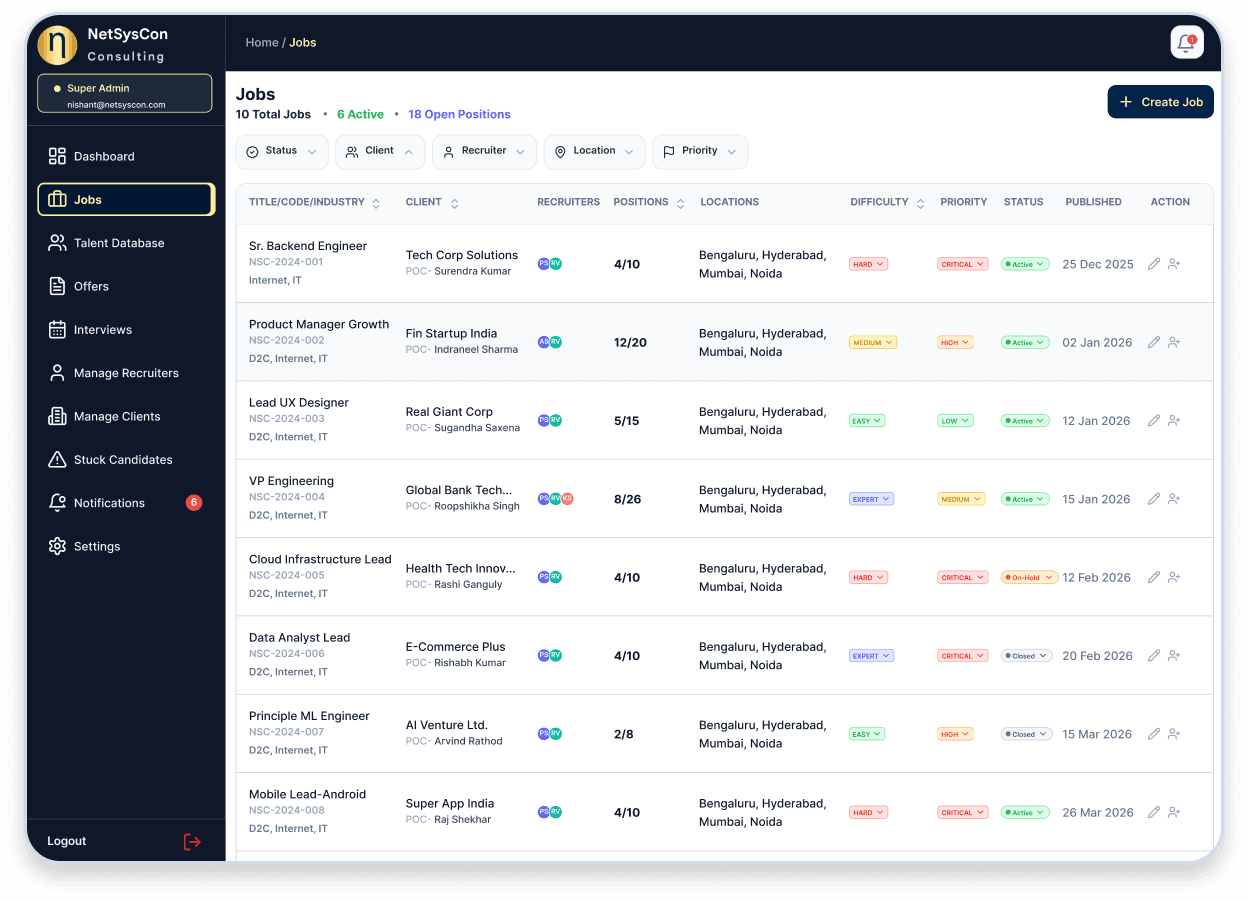
The legacy workflow separated candidate records, recruiter activity, client decisions and job publishing across tools, leaving teams without a reliable shared view of the hiring pipeline.
Siloed candidate data & duplicate leakage
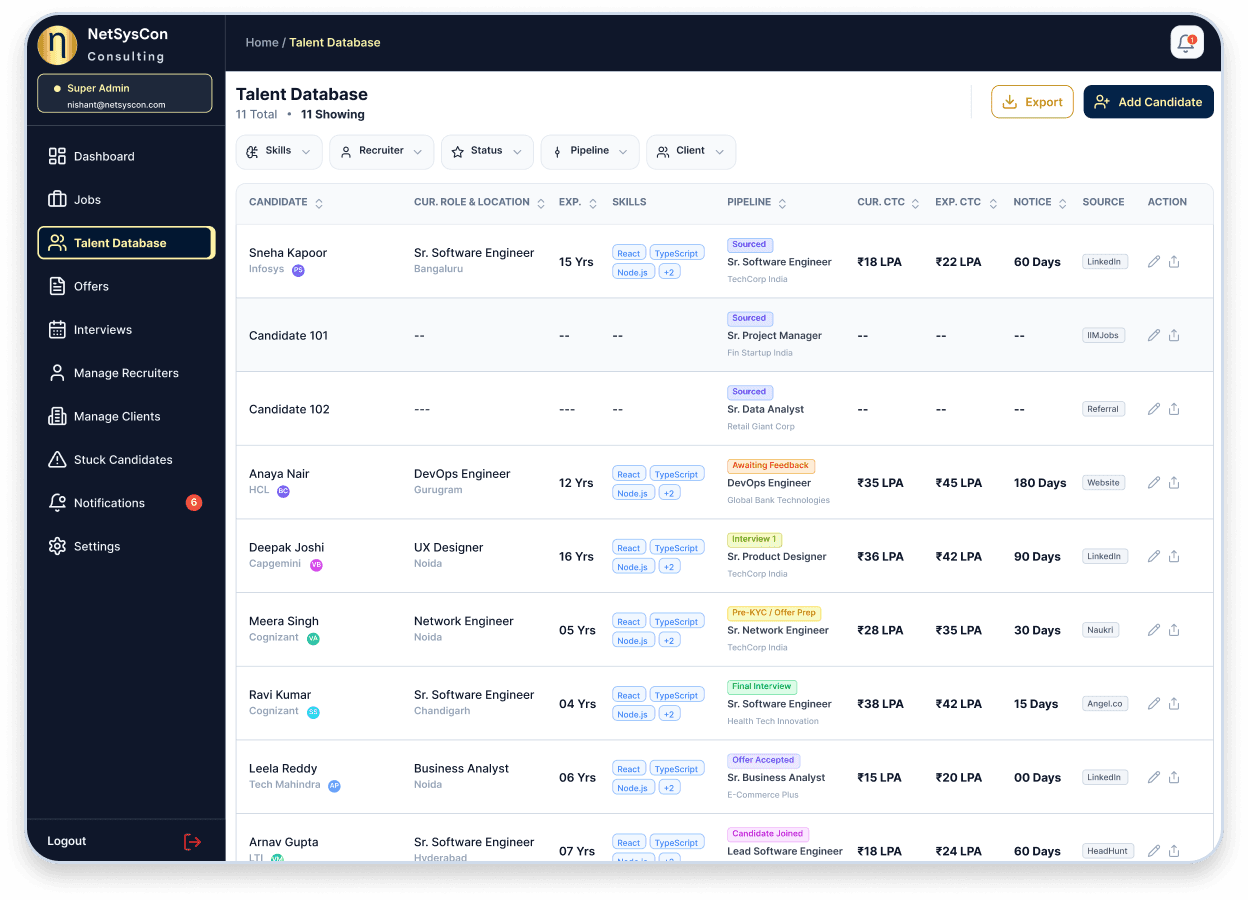
Candidates sourced across roles lacked a single system of record. Recruiter activity was unlinked, creating duplicate outreach and preventing reuse of existing database talent.
Limited real-time pipeline visibility
Delivery leads lacked granular tracking of candidate funnels, stage turnaround times (TAT), and delays in client feedback.
Disjointed client delivery & manual ingestion
Candidate profiles moved through unformatted email attachments and message threads, creating delays and no audit trail for client decisions. Job requisitions were configured manually in spreadsheets and posted separately to external web properties.
Core product & technical architecture
Three connected surfaces, one governed recruitment lifecycle
The platform connects the recruiter and lead desk, lightweight client collaboration, and the Admin Control Tower through shared workflow states and operational data.
NetSysCon Recruitment Operating System
Multi-tenant platform · Candidate lifecycle · Client delivery · Reporting and governance
Recruiter & Lead Desk
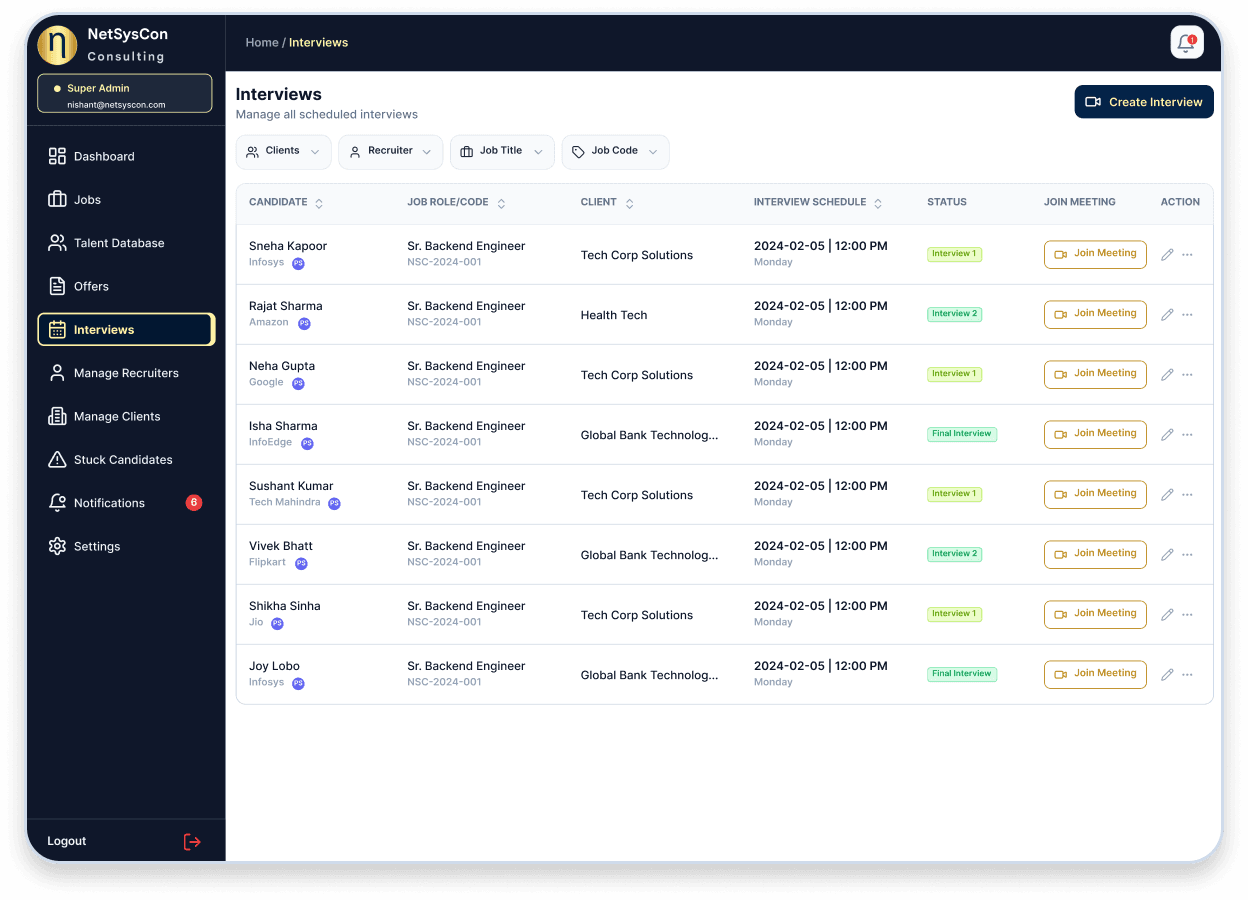
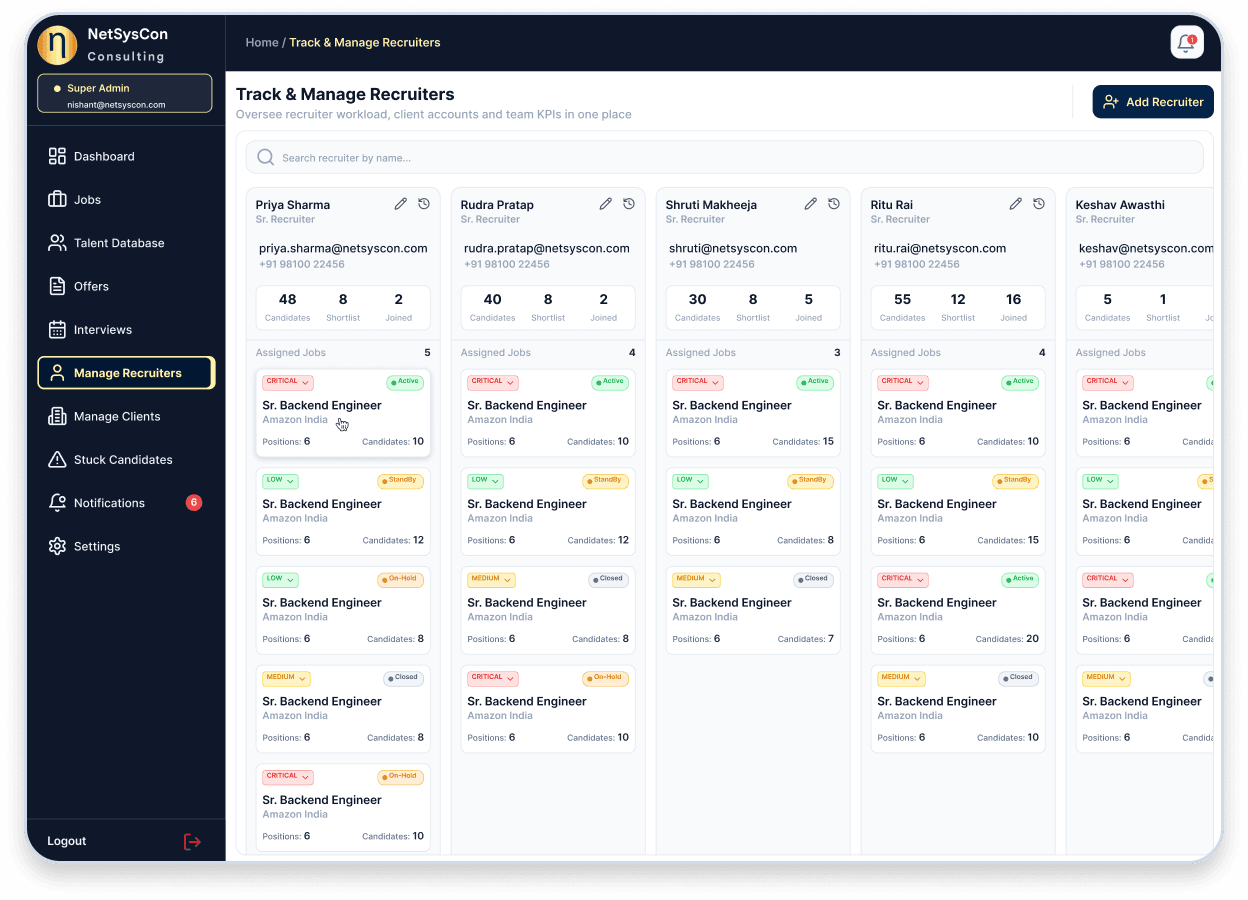
Job requisition management · One-click CTC calculator · Automated sourcing and resume versioning · Google Meet scheduler · EOD activity engine
Client Collaboration
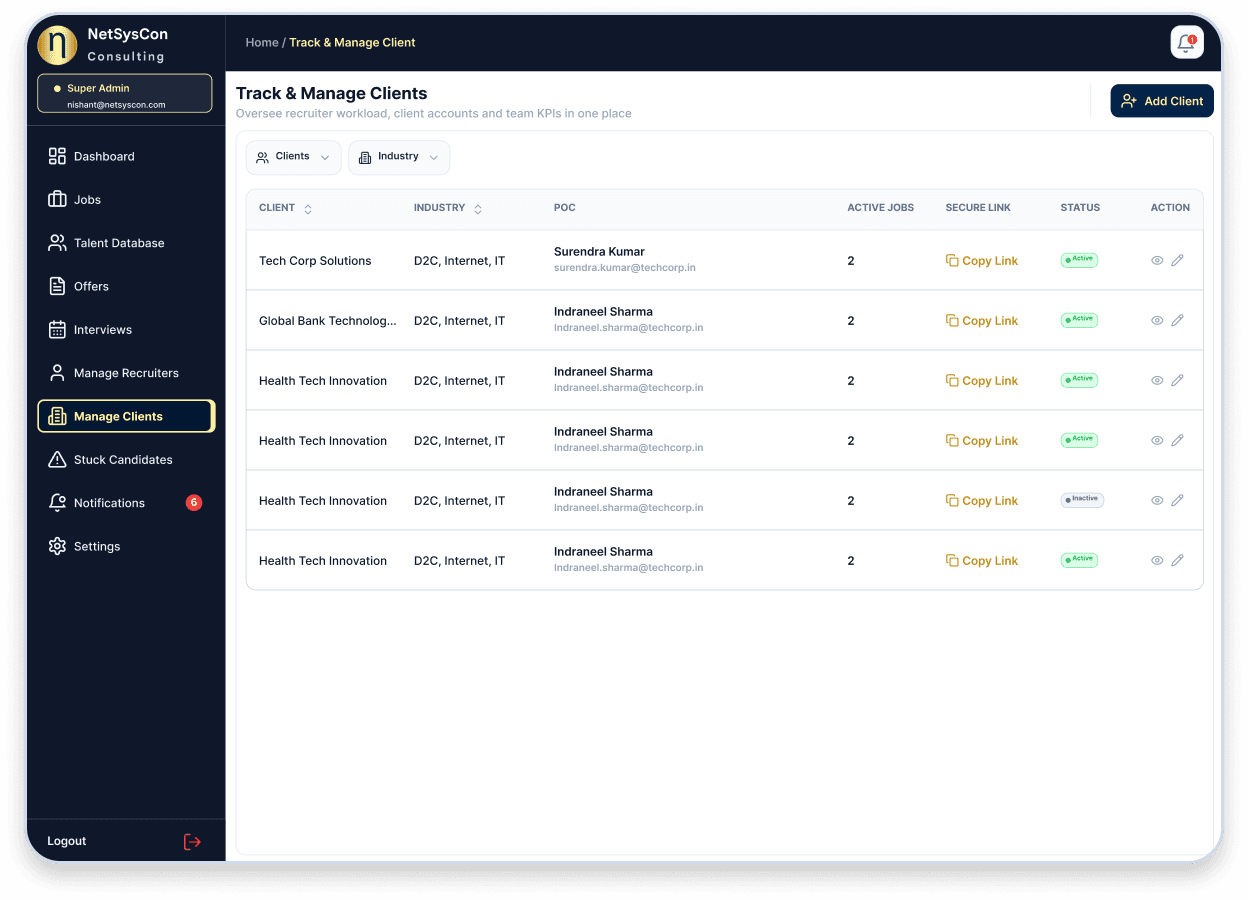
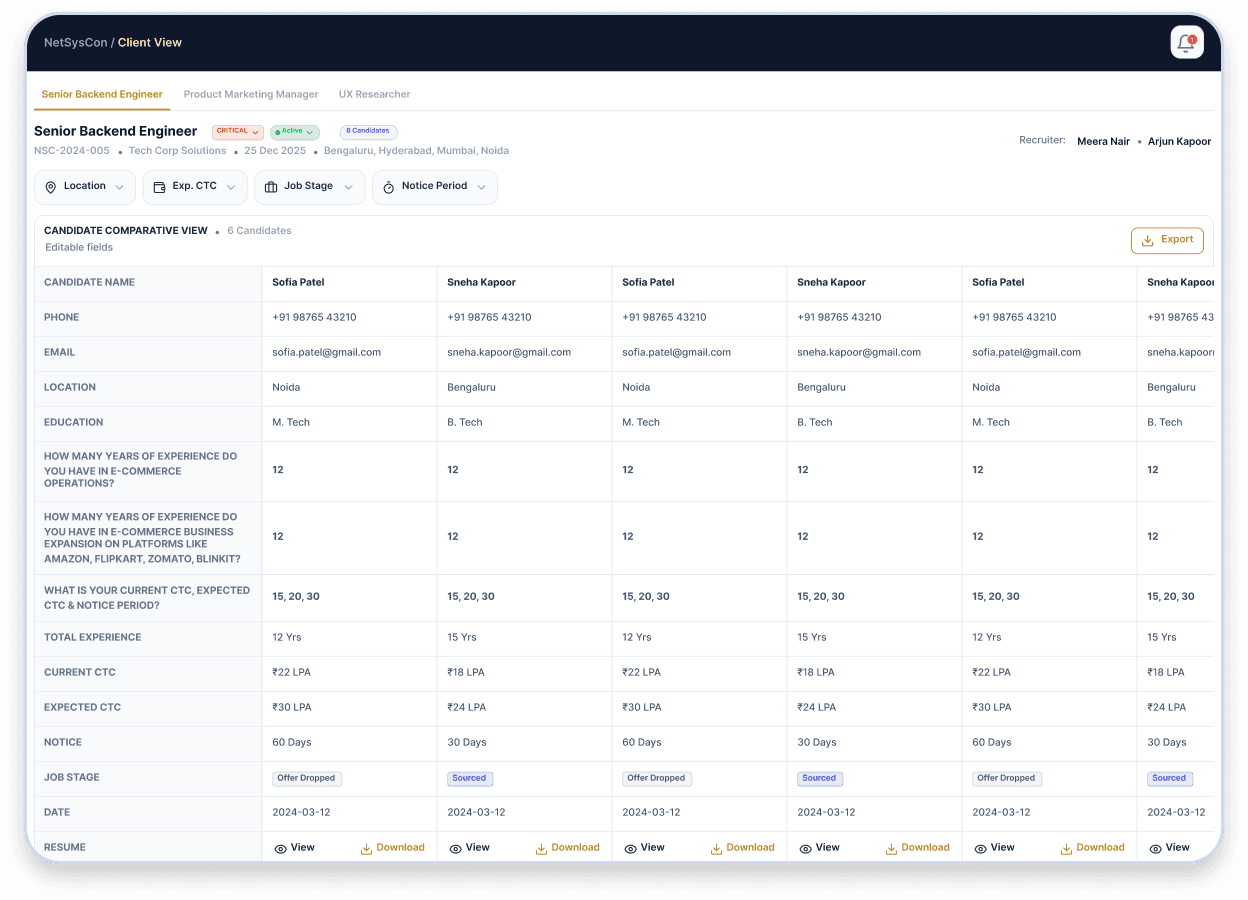
Passwordless magic access / 4-digit PIN · Side-by-side candidate attribute matrix · One-click decisions · Mandatory feedback
Admin Control Tower
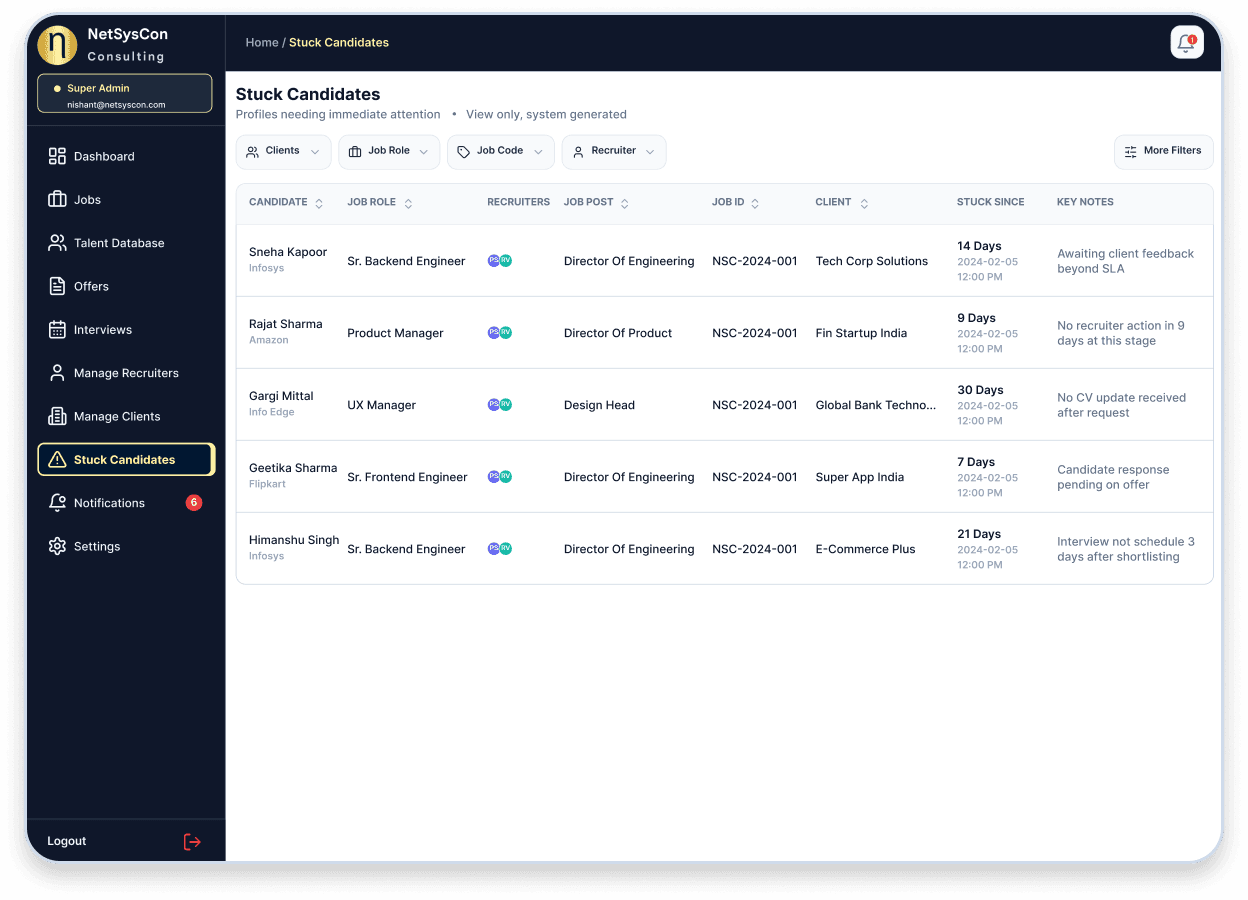
Dynamic funnel schema · Stuck-profile rules · WordPress bidirectional job-posting webhooks · Recruiter daily action and attendance tuning
Jobs · Candidates · Assessments · Offers · Attendance
Core product capabilities
Workflow automation across sourcing, review and delivery
Dynamic Funnel & Micro-Stage Engine
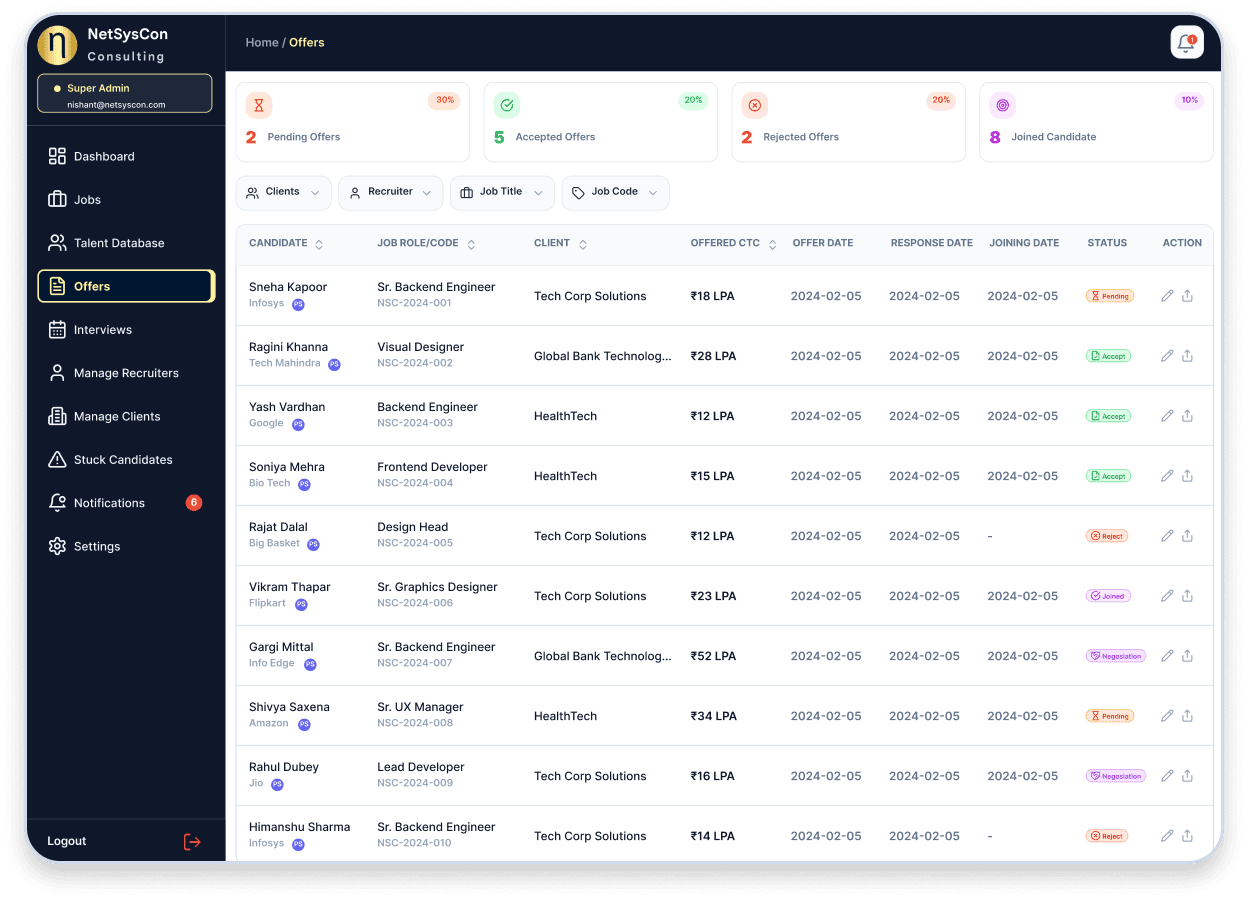
Configurable hiring funnels support a standardized multi-step lifecycle. The Offer stage tracks Offer Drafted, Offer Sent, Candidate Reviewing, Accepted, Declined and Negotiation Ongoing.
Built-in CTC modeler: An inline compensation calculator computes current, expected and offered CTC percentages within the pipeline, removing the need for external spreadsheets.
Automated stage guardrails: Moving a candidate to Offer Accepted triggers a post-mortem survey to document successful closing strategies for internal training.
Headless Job Publishing & Ingestion Pipeline
Job requisitions created by Super Admins synchronize with NetSysCon's public WordPress job board through automated REST endpoints.
Custom screening questionnaires configured in the RMS render dynamically on the public application page. Submissions route to the assigned recruiter's Sourced queue with the Web Application tag. Archiving or closing a role in the RMS automatically unpublishes the listing to prevent dead applications.
Client Portal & Secure Review Links
Secure tokenized web links give external hiring managers a structured view of candidate profiles, assessments, experience and compensation requirements.
Clients can select interview slots or log rejections directly. Negative feedback requires mandatory rejection tags. Client actions update candidate status to Awaiting Response and log recruiter alerts in real time.
Safety Controls & Automated Escalations
Candidates lingering beyond configured thresholds receive visual risk tags—for example, more than 7 days in Sourced or more than 5 days in Client Review. Profiles stuck in the Offer funnel for more than 48 hours trigger notifications to Team Leads and Super Admins.
Resume ingestion checks phone numbers as primary keys to flag duplicates immediately while preserving original profiles and historical notes.
Data Handling & Candidate Records
Centralized data backbone
Fragmented AppSheet and Google Sheets trackers were consolidated into a searchable repository with candidate interaction histories and versioned resumes.
Duplicate detection & resume history
Resume ingestion checks phone numbers as primary keys to flag duplicates immediately while preserving original profiles and historical notes.
Auditable KPI calibration
Managers can also make retroactive attendance adjustments with mandatory audit notes. Downstream performance metrics are recalculated instantly without altering raw pipeline timestamps. This provides more defensible operational metrics without introducing a separate HR application.
Enterprise role-based access control
Role-specific workspaces and field-level permissions
Granular role-based access control (RBAC) protects candidate and commercial data while giving each user the tools required for their part of the recruitment lifecycle.
Super Admin / Owner
Complete platform visibility: client fees, recruiter metrics, candidate PII, billing data and MIS reports.
Configure funnel states and SLA alert rules, add clients/recruiters, publish jobs and override system data.
Team Lead / Delivery Manager
Assigned portfolio jobs, recruiter throughput, client-specific TAT and escalation queues.
Assign recruiters to jobs, set daily sourcing targets, adjust attendance calibrations and handle escalations.
Recruiter
Assigned active requisitions, sourced candidates, contact details, resume version histories and daily to-do items.
Source talent, advance funnel stages, schedule Google Meet calls, model CTC percentages and run EOD summaries.
Client POC
Curated shortlist views, candidate profiles, assessment notes and interview schedules.
Review candidate submissions, log stage feedback, select interview slots and submit hiring decisions.
Candidate
Job details, custom qualification questionnaires and resume upload fields.
Submit applications and upload resumes without needing platform login credentials.
Technical Architecture
Recruitment platform & integrations
The platform connects the recruiter and lead desk, lightweight client collaboration, and the Admin Control Tower through shared workflow states and operational data.
Architecture & integrations
| Layer | Technology | What it supports |
|---|---|---|
| Recruitment platform | B2B multi-tenant RMS / ATS / HRMS | Multi-tenant platform · Candidate lifecycle · Client delivery · Reporting and governance |
| Job publishing & ingestion | WordPress · REST endpoints | Job requisitions created by Super Admins synchronize with NetSysCon's public WordPress job board through automated REST endpoints. |
| Client collaboration | Secure tokenized review links | Side-by-side candidate attribute matrix · One-click decisions · Mandatory feedback |
| Scheduling | Google Meet scheduler | Schedule Google Meet calls and client interview slots. |
| Operational analytics | KPI Calibration Tracker · CTC calculator · EOD activity engine | Recruiter daily action and attendance tuning, compensation calculations and end-of-day reporting. |
Measurable outcomes & business value
Less manual administration, faster feedback and fewer stalled profiles
Centralized data backbone
Fragmented AppSheet and Google Sheets trackers were consolidated into a searchable repository with candidate interaction histories and versioned resumes.
Reduced reporting overhead
EOD reporting tools and analytics dashboards automated daily recaps, saving hours of manual consolidation across the team.
Accelerated hiring cycles
Secure side-by-side client review interfaces helped hiring managers evaluate candidates and return feedback faster.
Eliminated pipeline slippage
Configurable stall-detection alerts and automatic escalations helped ensure high-potential candidates were not lost in operational handoffs.
What this demonstrates
Recruitment operations engineered around measurable delivery
Context-aware analytics
KPI denominator calibration accounts for attendance while preserving auditability and raw pipeline timestamps.
Governed collaboration
Secure client links, structured decisions and mandatory feedback tags replace fragmented email-based handoffs.
Lifecycle automation
Configurable funnels, job-board synchronization, duplicate detection and stage escalations connect day-to-day recruiter activity with operational oversight.
FAQ
NetSysCon RMS, explained
What was the system built to replace?
The fragmented Google Sheets trackers and low-code AppSheet wrappers used to manage multi-client recruitment operations.
How are clients involved in the hiring process?
Hiring stakeholders receive secure tokenized review links and can evaluate candidates, select interview slots, submit decisions and provide structured rejection feedback.
Does the RMS integrate with the public job board?
Yes. Job requisitions and status changes synchronize with the public WordPress job board through REST endpoints, and applicant submissions are routed into the assigned recruiter's workflow.
Work with Zolvify
Need to turn fragmented operations into a governed business platform?
Zolvify partners with teams to discover, design and engineer software that connects workflows, operational data and measurable delivery.