
Stop Guessing, Start Growing with MVP: Why Your “Perfect” Product is Actually a Trap
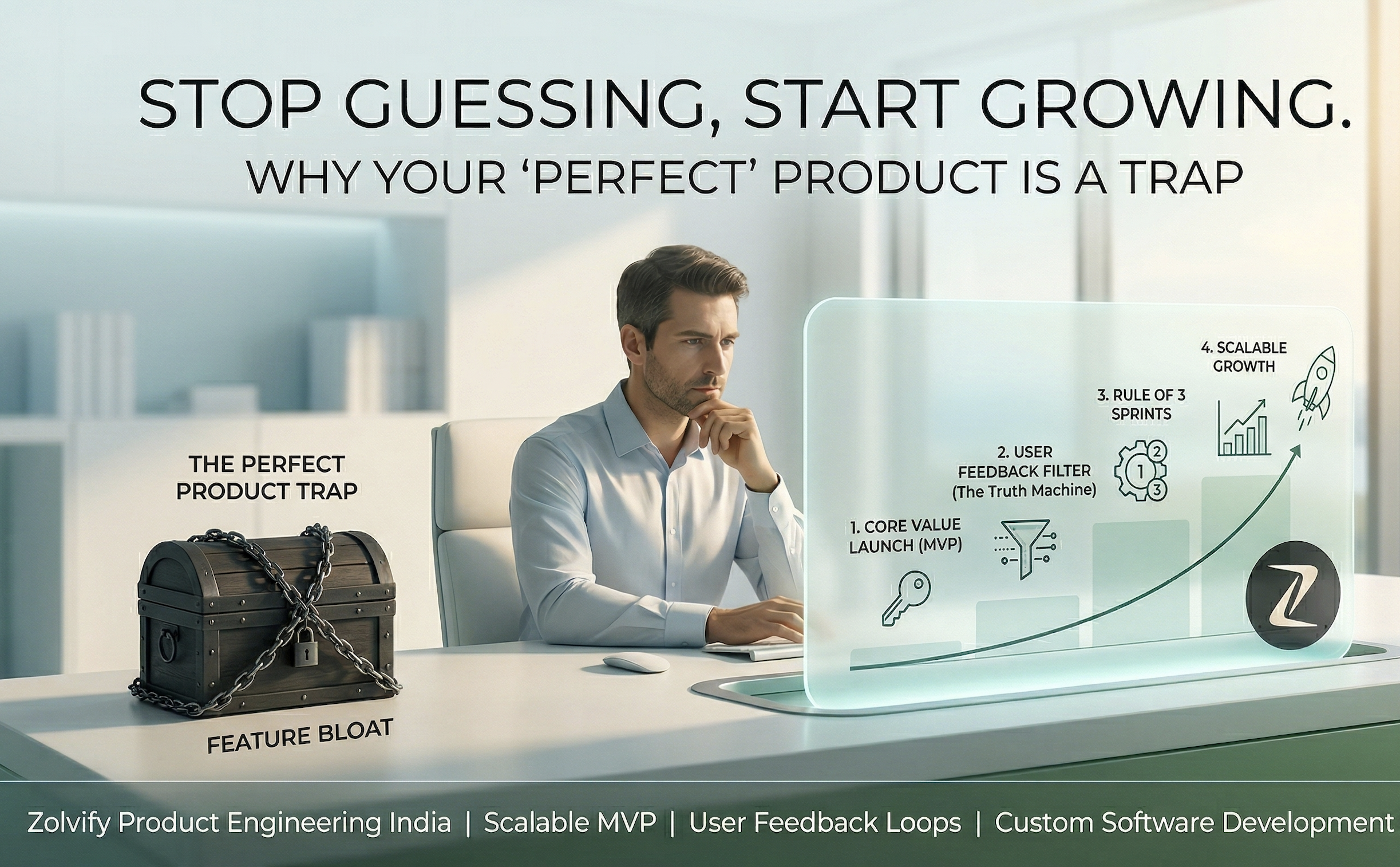
What is the hidden danger of building a complete product at once? The primary danger is Product-Market Mismatch. When you build every feature before launching, you are essentially gambling that your assumptions about user needs are 100% correct. If you’re wrong, you’ve wasted your entire budget on a “perfect” solution to a problem that doesn’t exist. An MVP (Minimum Viable Product) removes the guesswork by forcing you to face the truth of user behavior early.
The “Day One” Delusion
I see this often at Zolvify: A founder walks in with a vision so detailed it could fill a library. They’ve planned the dark mode, the referral bonuses, and the AI-powered chatbot before they’ve even proven that a single person wants to use their core service.
This is the Day One Delusion. It’s the belief that you can predict the future.
In reality, the moment your product hits the hands of a real user, your 50-page requirements document becomes obsolete. Users never do what you expect them to do. If you build the “whole product” at once, you’ve built a cage that’s too expensive to change once you realize you’re moving in the wrong direction.
The MVP as “The Truth Machine”
At Zolvify, we tell our partners: “Don’t build a product; build a Truth Machine.”
An MVP is the smallest piece of software you can build that will give you a “Yes” or “No” from the market. It’s not about being “minimum”; it’s about being viable.
- If they use the core feature: You have a business.
- If they don’t: You just saved six months of development time and $50k.
The “Rule of 3” Framework: How We Build at Zolvify
We don’t just “cut features.” We prioritize Impact. Here is the unique framework I use to help founders navigate the transition from a “Big Idea” to a “Scalable Business”:
1. The “Core Value” Launch
Identify the one thing your app must do. If that one thing was gone, would the app be useless? That’s your MVP. We launch this “Skateboard” to a group of known users (early adopters who feel the pain you’re solving). We aren’t looking for compliments; we’re looking for usage data.
2. The Feedback Filter
Once the app is live, we ignore what users say they want and look at what they actually do.
- Are they ignoring your “Main Feature” but using a secondary tool?
- Are they dropping off at the signup screen?
This is the “Truth” phase. It hurts, but it’s the most valuable data you will ever own.
3. The “Next Top 3” Sprints
Instead of going back to your original 200-feature list, we look at the data and pick the Top 3 Features that solve the biggest friction points found in Step 2.
- Implement.
- Measure.
- Repeat.
By focusing only on three things at a time, your development stays lean, your code stays clean, and your product stays relevant.
The Real ROI: De-Risking Your Future
In custom software development in India, the competition is fierce. The founders who win aren’t the ones with the most features; they’re the ones who iterate the fastest.
| Feature Bloat vs. Lean MVP | Feature-Heavy Product | Zolvify Lean MVP |
| Time to Market | 9-12 Months | 2-3 Months |
| Budget Risk | High (All-in) | Low (Iterative) |
| User Insight | Late (After Launch) | Early (Continuous) |
| Pivot Ability | Slow & Expensive | Fast & affordable |
Why “Zolvify” isn’t a Software House, We’re Builders
We aren’t here to just take your requirements and “ship it.” We’re here to be your Product Engineering partner. As a Product Manager, my job is to protect your runway and your vision by challenging your assumptions.
If you’re ready to stop guessing and start building something that actually works, let’s talk. We’ll help you find the “Truth” in your idea before you spend a penny on unnecessary features.